Skip to main content




Chinese Gender Predictor Calculator: Predict Your Baby’s Gender
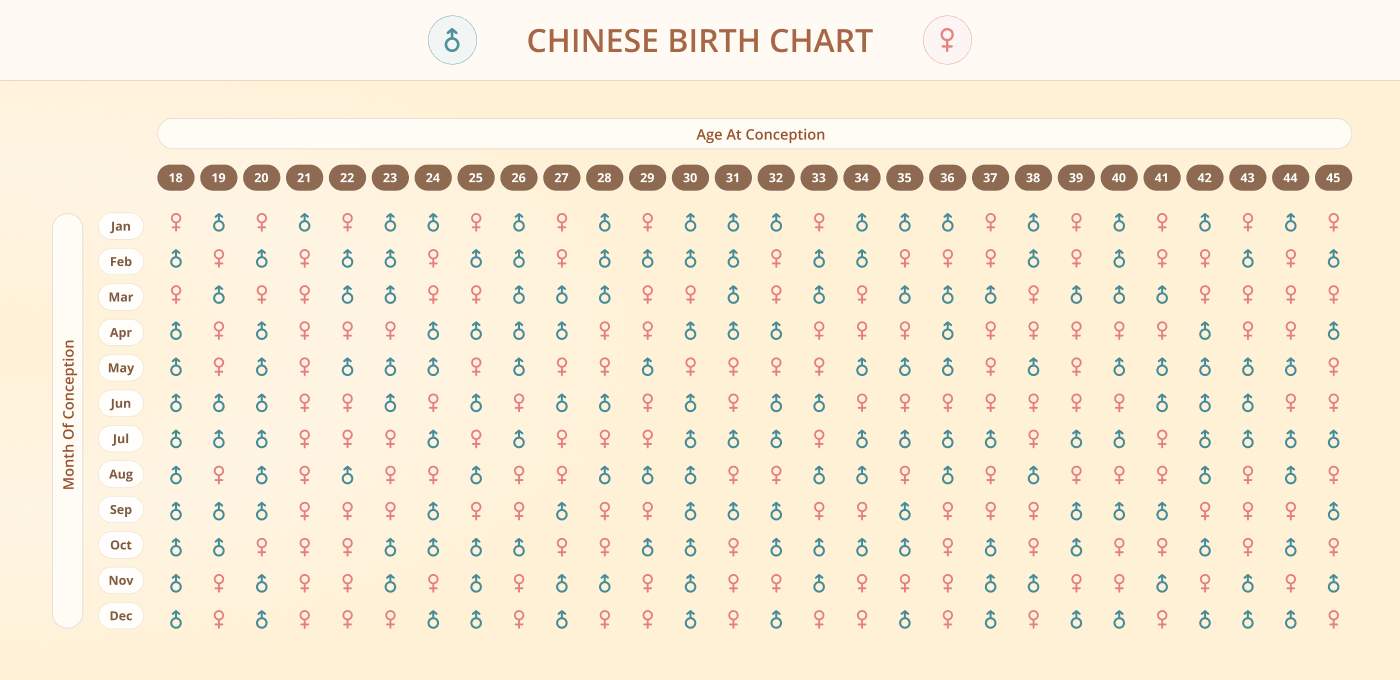
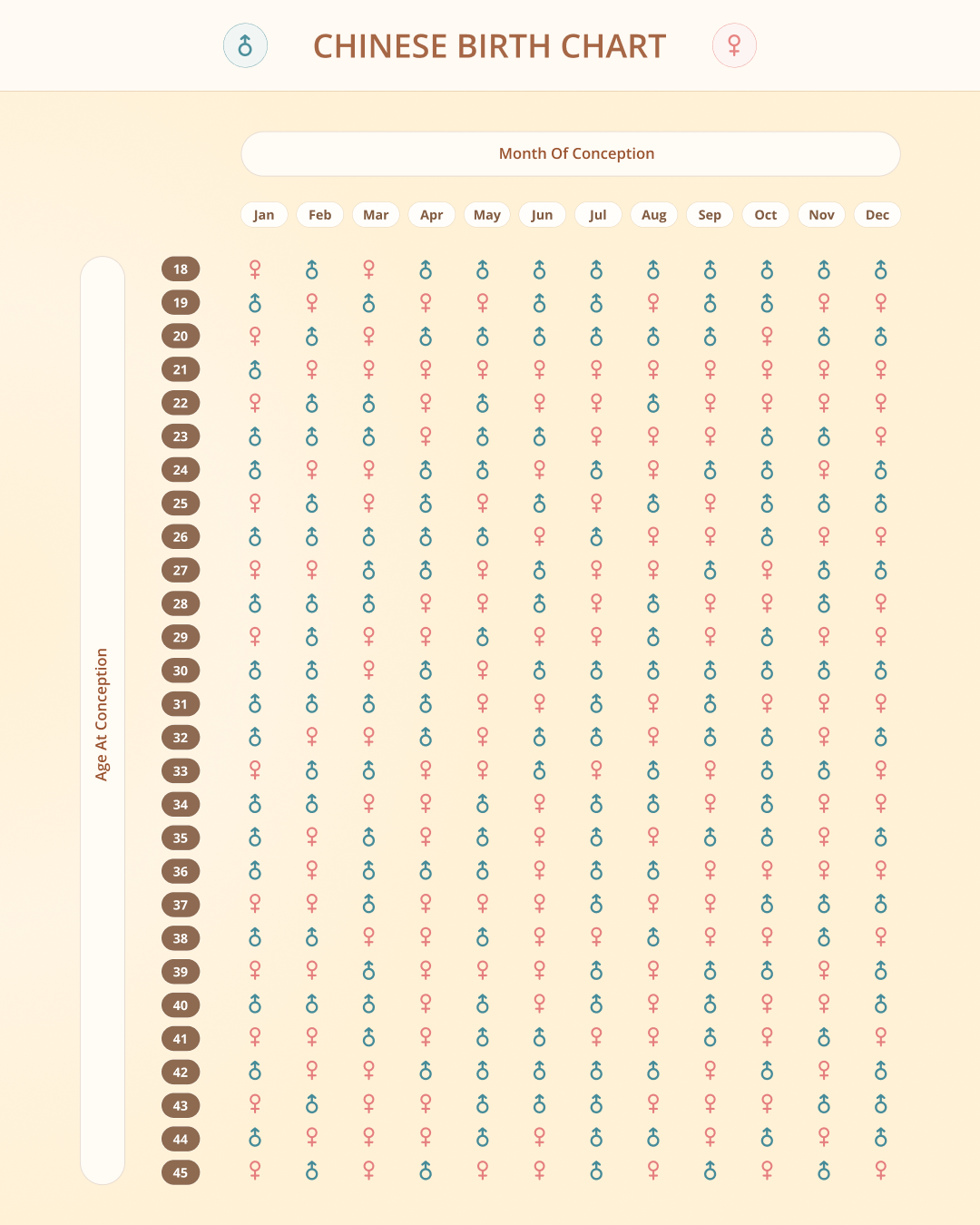
The Chinese Gender Predictor is a traditional chart used to guess whether a baby might be a boy or a girl based on the mother's age at conception and the month of conception.
Rooted in Chinese folklore, the chart compares these two factors to predict the baby's gender. Our Chinese Gender Predictor tool recreates this chart digitally, just enter your details to see the predicted result instantly.
Choose your method:
Tell us a bit more:
Try the Chinese Gender Predictor
Using the Chinese gender predictor calculator is quick and easy.
- Enter the mother’s age at the time of conception
- Select the month when conception likely occurred
- Click Predict Gender
The calculator will generate a prediction based on the traditional Chinese Gender Predictor Chart.
Many parents enjoy trying this chart during pregnancy as a fun way to guess their baby’s gender. However, it’s important to remember that the result is based on tradition rather than medical science.
What Is Chinese Age in the Gender Predictor Chart?
The traditional Chinese Gender Predictor Calendar uses a different age system known as Chinese age.
In this system:
Because of this, the Chinese age used in the gender chart may differ slightly from modern age.
When you enter your details in the Chinese gender chart calculator, the traditional chart combines the mother’s Chinese age with the conception month to generate a gender prediction.
How Accurate Is the Chinese Gender Predictor?
- The Chinese gender predictor is based on traditional folklore and has no scientific evidence supporting its accuracy.
- Many families still enjoy using the Chinese gender chart calculator as a fun activity during pregnancy, but it should not be considered a reliable method for determining a baby’s gender.
- If you're curious about other traditional gender prediction myths that parents often try, you can explore some of the most popular ones in our guide on old wives’ tales for baby gender predictions.
- For medically accurate information, healthcare providers rely on diagnostic methods such as ultrasound scans. In fact, certain ultrasound markers, like the hamburger sign in ultrasound are sometimes used by doctors to help identify female anatomy during a scan.
The History of the Chinese Gender Predictor
The Chinese Gender Predictor Calendar is a traditional tool rooted in Chinese cultural folklore that originated during the Qing Dynasty. Its origins date back around 300 years, with others suggesting up to 700 years. According to popular legend, the chart was discovered in a royal tomb and was originally crafted for use in the imperial court, reportedly as a way to predict male heirs for the royal family.
The method is based on the Chinese lunar calendar, which combines the mother's age with the lunar month of conception. Over time, this traditional chart became widely known as the Chinese gender chart, and today it is commonly used online through tools like the Chinese gender predictor calculator or Chinese gender chart calculator.
While the chart has no scientific basis for accurately predicting a baby's gender, many expecting parents still enjoy using the Chinese gender calculator as a fun and light-hearted way to engage with this old tradition during pregnancy. The Chinese Gender Predictor Tool simply brings this traditional chart into a digital format so it can be easily used today.
Disclaimer
The Chinese Gender Predictor is based on traditional folklore and is intended for entertainment purposes only. It is not a medically approved method for determining a baby’s gender. For accurate information about your pregnancy or your baby’s gender, please consult a qualified healthcare professional.
FAQs
- What is a Chinese Gender Predictor?
-
A Chinese Gender Predictor is a traditional tool that uses your age and the lunar month of conception to guess if your baby might be a boy or a girl. Often called a gender prediction calculator or chinese gender predictor, it’s a fun way to explore ancient customs with a simple chinese gender prediction calculator.
- How does the Chinese Gender Predictor tool work?
-
This tool works by taking your age at conception and the month you conceived (based on the Chinese lunar calendar) to make its prediction. When you enter your details into our chinese gender prediction calculator, it uses a traditional chinese gender chart—also known as a gender predictor chart—to show you whether you might have a boy or a girl.
- How Precise Is the Chinese Gender Predictor?
-
The accuracy of the Chinese Gender Predictor can vary. Many people enjoy using this gender calculator and find that it sometimes gives a prediction that feels right, but it isn’t scientifically precise. It’s meant to be a fun, traditional method rather than an exact forecast.
- What is the origin of the Chinese Gender Predictor?
-
The Chinese Gender Predictor comes from ancient Chinese traditions. It was developed using the mother’s age and the lunar calendar to predict a baby’s gender, and over time, it evolved into what we now call a chinese gender predictor chart. This method has been passed down through generations and remains popular for its cultural charm.
- How do I use the Chinese Gender Calculator on Baby Forest?
-
Using our chinese gender prediction calculator on Baby Forest is easy. Simply enter your age at conception and the month you conceived, and the calculator will use the traditional chinese gender predictor chart to give you a prediction.
- Can I use this tool for any pregnancy?
-
Yes, you can use our chinese gender prediction calculator for any pregnancy. It’s designed to be a fun tool for everyone, no matter the stage of your pregnancy. Just remember that its results are based on tradition, so it’s best enjoyed as a cultural experience rather than a guaranteed prediction.
- How do I predict my baby's gender?
-
If you’re curious about predicting your baby’s gender, you can try a traditional approach like the chinese gender predictor chart. By using our chinese gender prediction calculator, you simply input your age and conception month to get a prediction.